
Erasmus+ KA152-YOU Youth Exchange — project description from the perspective of European Trainee Academy (EUTA)
| Project | Our journey to success |
| Project No. | 2024-3-CZ01-KA152-YOU-000279577 |
| Programme | Erasmus+, KA152-YOU – Youth Exchanges |
| Applicant / sending organisation | Základní škola a mateřská škola Puklice (Czech Republic) |
| Hosting partner | European Trainee Academy (EUTA), Benalmádena, Spain |
| Activity | 21–28 September 2025, Benalmádena (Spain) |
| Participants | 38 (19 Czech, 19 from EUTA) |
| Project card | Erasmus+ Project Results Platform |
Hosting the exchange at EUTA
At the European Trainee Academy (EUTA) in Benalmádena, we were proud to act as the hosting partner for the Erasmus+ youth exchange “Our journey to success.” For an academy that works with young people from all over the world every day, this project brought together two things we care about most: hands-on, non-formal learning and giving young people who face barriers a real chance to grow. Over eight days in southern Spain, we welcomed a group of pupils from ZŠ Puklice — a small rural school in the Czech Republic — and paired them with a group of our own young people to work, learn and live side by side.

Why this partnership mattered to us
EUTA has long experience in non-formal education, language learning and building the employability of young people. ZŠ Puklice, on the other hand, brought a strong social mission: reaching children from rural areas and socio-economically disadvantaged families, many of whom had never travelled abroad. We saw the two worlds as complementary. Our role was to provide the full learning environment — accommodation and meals in our closed campus, local transport, the excursions, and, above all, the educational programme and its facilitators. Our director and our academic lead, David, guided the methodology, while the Czech coordinating team looked after the pastoral care and inclusion of their pupils. From the first online preparatory meetings to the daily coordination on the ground (we ran everything through a shared WhatsApp group), it was a genuine partnership of equals.
Ready to Start Your Erasmus+ Journey?
Explore our Erasmus+ funded teacher courses and student programmes in Benalmádena, Spain.

A truly international group
The 38 participants were split into two groups of 19. The Czech group came from the lower secondary level of ZŠ Puklice, with a high proportion of pupils from disadvantaged backgrounds. Our EUTA group was deliberately diverse: although most of these young people live and study in Spain, they come from many different countries, so the Czech pupils were immediately immersed in an authentic multicultural setting. We also worked intentionally across age groups — our more experienced older participants (16–19) supported the younger ones with English and soft skills, and we mixed the teams so that this peer-to-peer mentoring happened naturally. It turned out to be one of the most valuable dynamics of the whole week.
The programme we delivered
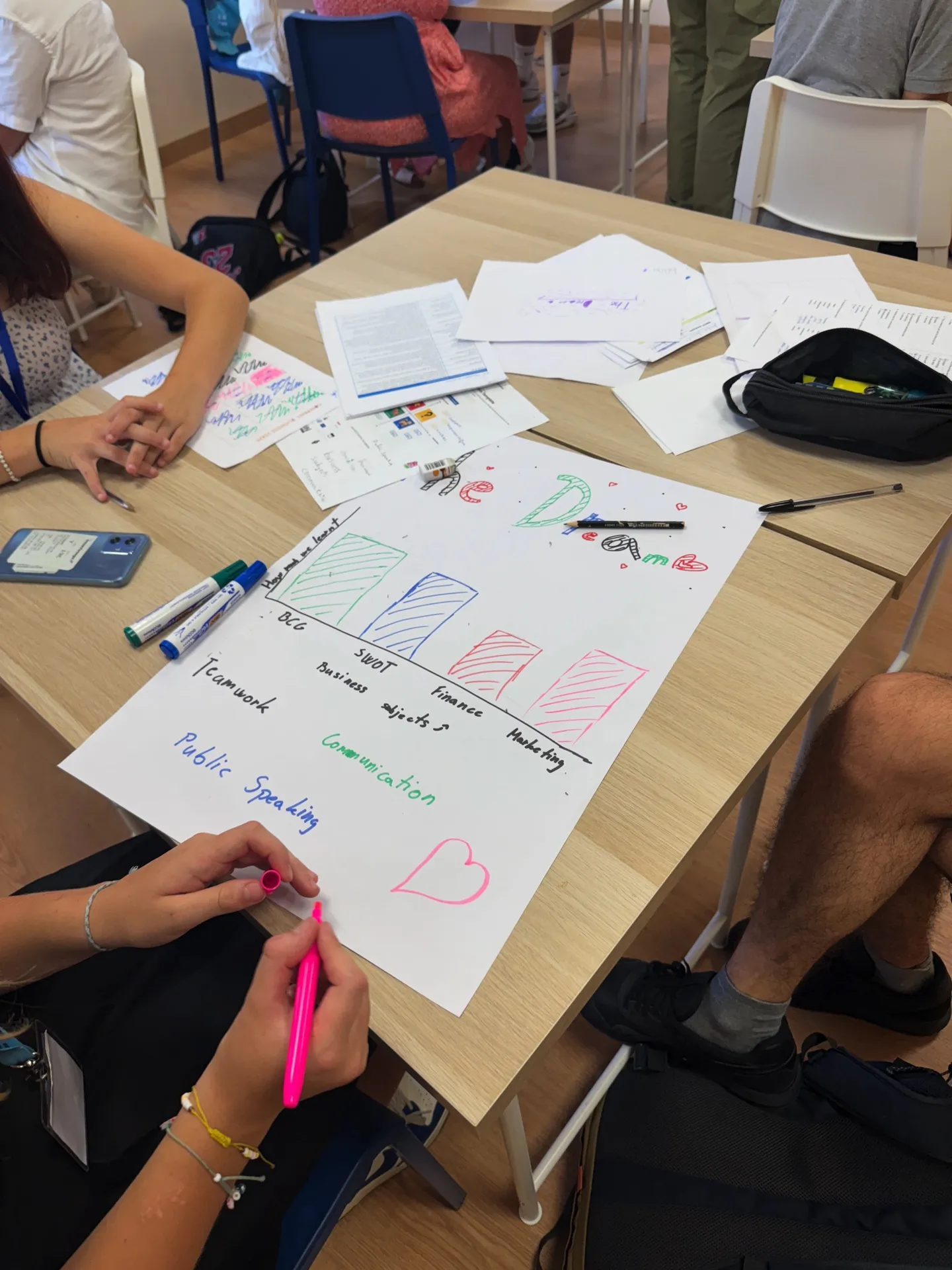
We built the eight days entirely around experiential learning — no lectures, just doing, reflecting and doing again. After an opening day of ice-breakers and intercultural activities that dissolved the fear of speaking, we launched the Mini-Enterprise Challenge. Mixed international teams identified a real problem, shaped it into a business idea, calculated fixed and variable costs, set prices, built a simple business plan and finally pitched it to a jury. To connect theory with the real world, we took the group to the Mayan Monkey Chocolate Factory in Mijas, where our local partners walked the participants through pricing, margins, sustainable packaging and Fair Trade — and where the teams designed and made their own product.

The second half of the week was devoted to real-life simulations. We turned our spaces into an airport terminal (check-in, security, passport control, boarding), staged hotel problem-solving, ran a budget “shopping challenge,” and put every participant through a mock job interview in English. To push financial literacy beyond the classroom, we organised an excursion to Gibraltar — a chance to step outside the EU and the Schengen area, deal with border control, handle two currencies, convert exchange rates and compare real prices. For most of the Czech pupils, who had rarely left their country, this was an unforgettable practical lesson. The exchange closed with final presentations, a group reflection and the awarding of Youthpass certificates.

What the project achieved
The change in the young people was visible day by day. Participants lost their fear of communicating in English and of making mistakes; they became more confident and independent; and they picked up practical habits in budgeting, teamwork and problem-solving that they could take home. All 38 received a Youthpass certificate recognising the competences they had gained. For us at EUTA, the project confirmed that our non-formal methods work extremely well with mixed, inclusive groups, and it strengthened our network of international partners and local collaborators (such as the Mayan Monkey Chocolate Factory and our associated Benalmádena International College). Hosting a group with such a strong inclusion focus also sharpened our own practice in supporting participants with fewer opportunities.

Sharing the results
On our side, we shared the outcomes of the project through the academy’s social media channels and website, and we displayed the participants’ outputs on the notice boards in our classrooms, so that other visitors to the academy could see what the exchange produced. We continue to raise awareness of the project among our other groups and partners, and the results are also published on the Erasmus+ Project Results Platform, alongside the dissemination carried out by ZŠ Puklice in their own community and region.
Looking ahead
For European Trainee Academy, “Our journey to success” was more than a week of activities — it was proof of what a well-matched partnership can do. A group of quiet, uncertain rural pupils left Benalmádena as confident, English-speaking, financially literate young people, and our own participants grew as mentors and team-mates in the process. We would gladly build on this experience with ZŠ Puklice and with new partners in the future, because it showed, very concretely, that a young person’s starting point does not decide where they can go.

Project “Our journey to success” (2024-3-CZ01-KA152-YOU-000279577) is co-funded by the European Union. Views and opinions expressed are however those of the author(s) only and do not necessarily reflect those of the European Union or the European Education and Culture Executive Agency (EACEA). Neither the European Union nor EACEA can be held responsible for them.